



Before you compare an hourly rate, make sure you’re comparing the whole cost. Here’s what typically sits on top of a casual’s base pay and why a staffing partner’s bill rate is usually a fairer comparison than it first looks.
When employers weigh up managing casuals directly against using a staffing agency, the comparison usually comes down to one number: the hourly rate. An agency’s bill rate looks higher than the award rate you’d pay a casual on your own books, so managing it in-house looks like the cheaper option.
That comparison only holds up if the award rate is the whole cost of employing someone. It isn’t. By the time you add the statutory charges every employer is required to pay, plus the admin, compliance and turnover costs that never show up on a payslip, the gap between “doing it yourself” and using a partner is a lot smaller than the headline rates suggest and sometimes it runs the other way.
The statutory stack most employers underestimate
Every casual you put on your own payroll carries a set of statutory on-costs before you get to anything discretionary. None of these appear in the award rate, and most businesses don’t add them all up until they’re asked to.
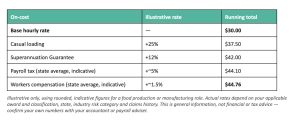
- Casual loading: a standard 25% on top of the base award rate, paid in lieu of paid leave entitlements (Fair Work Ombudsman).
- Superannuation Guarantee: 12% of ordinary earnings, and since 1 July 2026 it must reach the employee’s fund within seven business days of every pay run, not quarterly (ATO).
- Payroll tax: charged on total wages once you’re over your state’s threshold – currently 4.75% in Queensland (threshold $1.3m), 4.85% in Victoria (threshold $1m), and 5.45% in New South Wales (threshold $1.2m) (state revenue offices).
- Workers compensation: set by state and industry risk classification, Queensland’s average sits at $1.343 per $100 of wages, Victoria’s average premium is 1.8%, and NSW premiums rose a further 8% on average for 2025–26, with your actual rate driven by industry and claims history (WorkCover Qld, WorkSafe Victoria, icare NSW).
An illustrative example
Take a casual process worker on an indicative $30 base hourly rate. By the time casual loading, super, an average payroll tax rate and an average workers compensation rate are added, the real cost of that hour is well above the $30 on the award summary — before a single dollar has gone toward recruiting, inducting or rostering them.
The costs that never show up on a payslip
The statutory stack is only part of the picture. Managing casuals directly also means carrying a set of operational and compliance costs that don’t have a line item but are very real:
- Recruitment and advertising – sourcing, screening and interviewing every time you need to fill a shift or backfill a no-show.
- Induction and WHS training – repeated with every new starter, which adds up fast in roles with higher casual turnover.
- Payroll administration – now a weekly discipline rather than a quarterly one, with the seven-business-day Payday Super deadline applying to every pay run.
- Underpayment and compliance risk – getting award interpretation, classifications or super wrong exposes the business to back-pay claims and Fair Work penalties.
- The Employee Choice Pathway – since February 2025, eligible casuals can request conversion to permanent employment after six months (twelve for a small business), and you’re required to respond in writing within 21 days on specific grounds (Fair Work Ombudsman).
- Claims history – a single workers compensation claim can affect your premium rate for years afterwards, regardless of how the rest of your workforce performs.
What’s already built into an agency’s bill rate
A staffing agency’s hourly rate looks higher because it isn’t just a wage – it’s a single line that already includes the wage, casual loading, super, payroll tax, workers compensation, recruitment, induction, payroll administration and the compliance risk of employing that person in the first place.
When a labour hire provider engages a worker as employer of record, all of the above sits with them: the statutory on-costs, the seven-day super clock, the award interpretation, the Employee Choice Pathway administration, and the workers compensation claims history. You get the labour without carrying the liability, and without an internal team assembling and re-checking that stack every pay cycle.
Employers often compare our rate to their own base award rate, which isn’t really a like-for-like comparison. Once you add casual loading, super, payroll tax and workers comp and then the recruitment, induction and compliance time on top – the gap closes a long way, and what you’re really paying for with a partner is certainty. Garry Wadhwa, CEO, Blaze Staffing
Make it a fair comparison
Before deciding that managing casuals yourself is the cheaper path, it’s worth doing the full sum: base rate, casual loading, super, payroll tax, workers compensation, and a realistic estimate of the time your team spends recruiting, inducting, rostering and staying on top of compliance for that role. Compare that total to a provider’s all-in bill rate, not just to the award rate on its own.
Blaze Staffing supports food production, pharmaceutical, manufacturing and industrial clients across Melbourne, Sydney and Brisbane as employer of record – meaning the statutory on-costs, payroll administration and compliance obligations covered in this article sit with us, not with you.
If you’d like a rate comparison based on your actual roles, awards and locations, we’re happy to run the numbers with you.
Get in touch with Blaze Staffing on 1 300 008 005 or visit www.blazestaffing.com.au to compare the true cost of your workforce.
This article provides general information only and does not constitute financial, tax or legal advice. Statutory rates and thresholds — including casual loading, superannuation, payroll tax and workers compensation premiums — vary by award, classification, state and industry, and are subject to change. Figures cited are current as at July 2026 based on published rates from the Australian Taxation Office, Fair Work Ombudsman, and state revenue and workers compensation authorities. Employers should confirm their own obligations with their accountant, payroll provider or relevant regulator.

Related Blogs
Read news and insights into a variety of industries
Powering Australia’s Future 2025 Report
Download the Powering Australia’s Future 2025 Report and gain exclusive insights into the industries driving Australia’s economy forward. Learn how innovations, workforce trends, and sustainability initiatives are shaping manufacturing, logistics, and more. What’s Inside: Manufacturing Growth: A 5% projected increase in output by 2025, driven by robotics, AI, and Industry 4.0 technologies. Workforce Challenges &…

Navigating Compliance in 2025: Business Priorities
In 2025, Australian companies are entering a transformative phase of compliance, driven by significant changes in legislation, including the Closing Loopholes Acts and the criminalisation of wage theft. For companies navigating this new era, understanding these changes and implementing effective compliance strategies is critical not only to avoid penalties but to maintain trust with employees…

Hiring is Just About Posting on Seek? Think Again!
Hiring the right talent has never been more complex. With AI-generated resumes flooding the market, screening candidates is no longer as simple as reviewing a CV and scheduling interviews. You might think posting a job on Seek or other platforms will get the right candidate knocking on your door, but it’s time to think again….

1 July 2024 (and beyond): New Minimum Wage and Superannuation Updates
As businesses plan their budgets for the new financial year, estimating payroll costs is essential. This year, we are fortunate to have received an early announcement from the Fair Work Commission regarding their decision on the annual Minimum Wage Review. This early insight will allow businesses to better forecast their wage costs for the next…

Top 3 Benefits of Choosing a Professional Recruitment Agency Over an In-House Talent Acquisition Team
In the dynamic realm of talent acquisition, businesses are constantly seeking ways to optimize their recruitment processes to secure top-tier talent efficiently and effectively. One common dilemma faced by companies is whether to rely on an in-house talent acquisition team or enlist the expertise of a professional recruitment agency. In this blog post, we’ll delve…
Navigating Recent Changes in Australian Employment Laws: A Guide for Employers
In the ever-evolving landscape of Australian employment laws, it’s essential for HR professionals and employers to stay abreast of recent developments to ensure compliance and foster a conducive work environment. One significant recent change is the Fair Work Amendment (Closing Loopholes) Bill 2023, colloquially known as the “Closing the Loopholes Bill,” which brings about substantial…
