


On 26 June 2026, Victoria’s Labour Hire Authority (LHA) cancelled the labour hire licence of Hudson Global Resources Pty Ltd, one of the best-known names in Australian recruitment. The regulator found the company’s directors were not fit to run a labour hire business, citing widespread legal non-compliance and significant outstanding debts. From 10 July 2026, Hudson could no longer lawfully supply labour hire workers in Victoria.
Hudson was not alone. In June 2026 alone, the LHA cancelled nine more licences and refused another eight applications or renewals. Across the first half of 2026, Victoria refused or cancelled close to 200 licences.
If you host labour hire workers, these numbers matter to you. Here is why.
The host is not a bystander
Many businesses assume that once they sign with a labour hire provider, pay rates, penalties, super and conditions are the provider’s problem. Operationally, that is true. The provider is the employer of record and runs payroll.
Legally, the picture is different. In every state with a licensing scheme, it is an offence to use an unlicensed labour hire provider, not just to be one. The responsibility to check sits with the host.
In Victoria, penalties for using an unlicensed provider can exceed $660,000 for a corporation and $160,000 for an individual. Queensland, South Australia and the ACT all run their own schemes with their own penalties, and a licence in one state does not cover work in another.
How underpayment becomes your problem
Licensing and pay compliance are directly connected. To hold a licence, a provider must comply with workplace, tax and superannuation laws, and the people running it must be fit and proper. When a provider underpays award rates, skips penalty rates or falls behind on super, that is exactly the conduct that gets a licence cancelled.
That creates a chain reaction for the host:
- Your provider loses its licence. Keep using it, even for a few days, and you are now committing an offence.
- Your workforce disappears overnight. Workers must be moved to a licensed provider or employed directly, often mid-season, mid-contract or mid-production run.
- Your name is attached to the problem. If a regulator or the Fair Work Ombudsman investigates, your site, your rosters and your supplier choices are part of the story. Under the Fair Work Act, businesses knowingly involved in underpayment can face accessorial liability.
- Your reputation takes the hit. Customers, auditors and buyers increasingly ask who is in your labour supply chain and whether those workers are paid correctly.
The rules just got tougher
From 1 June 2026, Victoria introduced a stricter fit and proper person test, financial viability declarations, and broader checks on a provider’s compliance history. South Australia expanded licensing to every industry from 29 January 2026, with providers required to be licensed by 29 July 2026.
The direction is clear. Regulators are removing operators that cut corners, and they expect hosts to do their homework.
What a good operator looks like
The cheapest charge rate is often the most expensive decision you can make. A rate that looks too good usually means something is being left out, whether that is correct award classification, overtime and penalty rates, super, or insurance.
A provider worth working with will:
- Hold a current licence in every state where you need workers, and show you the licence number without being asked.
- Pay the correct award rates, penalties and loadings, and apply increases like the 4.75% award rise from 1 July 2026 on time.
- Pay super on time, in line with Payday Super rules that now apply every pay cycle.
- Classify workers correctly under the right award or enterprise agreement.
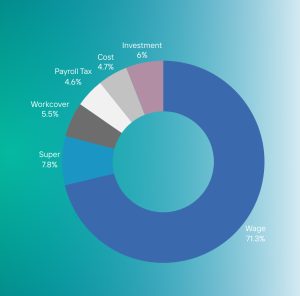
- Be transparent about charge rates, so you can see where the money goes.
- Run proper inductions and share responsibility for safety on your site.
Five checks to run this month
- Search every provider you use on the relevant state licence register.
- Sign up for licence change alerts. Victoria offers a free Follow my Providers tool.
- Ask each provider how they calculate charge rates and apply award increases.
- Confirm they are licensed in every state where they supply you.
- Build licence verification into supplier onboarding and review it at least quarterly.
Why businesses choose Blaze Staffing
Blaze Staffing is a licensed national labour hire provider supporting food production, pharmaceutical, manufacturing and industrial businesses. As employer of record, we manage payroll, award interpretation, penalty rates, super and SuperStream data, and we treat compliance as the foundation of every placement, not an afterthought.
Our charge rates reflect what it genuinely costs to employ workers correctly. That is what protects our workers, and it is what protects you.
Talk to Blaze Staffing about your workforce and your risk.
Call 1300 008 005
This article provides general information only and does not constitute legal advice. Labour hire licensing requirements and penalties vary by state and are subject to change. Seek independent advice about your specific obligations. Licensing figures sourced from the Labour Hire Authority (Victoria) monthly licensing action reports and media releases, 2026.

Related Blogs
Read news and insights into a variety of industries

Top 3 Benefits of Choosing a Professional Recruitment Agency Over an In-House Talent Acquisition Team
In the dynamic realm of talent acquisition, businesses are constantly seeking ways to optimize their recruitment processes to secure top-tier talent efficiently and effectively. One common dilemma faced by companies is whether to rely on an in-house talent acquisition team or enlist the expertise of a professional recruitment agency. In this blog post, we’ll delve…

Navigating Recent Changes in Australian Employment Laws: A Guide for Employers
In the ever-evolving landscape of Australian employment laws, it’s essential for HR professionals and employers to stay abreast of recent developments to ensure compliance and foster a conducive work environment. One significant recent change is the Fair Work Amendment (Closing Loopholes) Bill 2023, colloquially known as the “Closing the Loopholes Bill,” which brings about substantial…
High ROI Recruitment: Less than $2/hour!
Understand the Labour Hire Charges and Unlock Business Growth Have you ever pondered over the intricate dance of talent acquisition within your organisation? Or marvelled at the seamless integration of diverse skill sets across departments? Well, let’s unpack the essence of labour hire recruitment agencies and their contributions to the tapestry of your workforce. Picture…

Navigating Business Uncertainty in 2024: The Strategic Advantages of Partnering with a Temporary Placement Agency
As we embark on the intricate journey of navigating the financial landscape in 2024, it’s prudent to discuss a strategic ally: collaborating with a temporary placement agency (also commonly known as a labour hire agency). Let’s explore the myriad ways in which such collaboration can furnish your business with a competitive edge, offering flexibility, cost-effectiveness,…

The Secret to Staying Ahead
Future-Proofing Your Staffing Hires Let’s face it – the job landscape is constantly evolving. With advancements in technology and an ever-increasing demand for specialised skills, it’s easy to feel overwhelmed and fall behind. The secret to staying ahead of the game all lies in the hiring process. By carefully selecting candidates who have the potential…

Keeping It Casual
Increasing efficiency, reducing costs, and improving job satisfaction The COVID-19 pandemic has brought about a lot of changes in the workforce. Many businesses have had to adapt to new ways of working, and this has led to a shift in the types of roles that are in demand. One of the common themes that we…
