



Your super is your money: How to check it’s being paid.
A practical guide for workers before Payday Super starts on 1 July 2026
Superannuation is not a bonus or a nice extra. It is part of your employment entitlement and part of your long-term financial future. If your employer is required to pay super for you, that money belongs in your nominated super fund.
The challenge is that many workers only check super once a year, or only look at the super amount shown on their payslip, without confirming whether the money actually reached their fund. That needs to change.
From 1 July 2026, Payday Super will require employers to pay superannuation contributions at the same time they pay wages, with contributions reaching the employee’s nominated super fund within 7 business days. This reform is designed to make unpaid or late super easier to identify and harder to ignore.
You do not need to wait until Payday Super starts. You can check your super now.
Why this matters
Super is your money. If it is not paid, is paid late, or is paid to the wrong fund, your retirement savings can be affected over time. For casual, shift, production, warehouse and labour hire workers who move between jobs or work variable hours, missed super can be easier to overlook.
Most employers do the right thing, but payroll mistakes can happen. Fund details can be wrong. Payments can fail. Amounts can be listed on a payslip before they have actually landed in the fund. That is why workers should check the numbers, not just assume everything is correct.
Check your super fund first
Log in to your super fund account and check the employer contributions that have actually been received. Look at the dates, amounts and employer name.
Check ATO online services through myGov. This can help you see super information reported to the ATO and find any lost or multiple super accounts.
Compare contributions against your payslips. Your payslips should show super contribution information, but the key question is whether the money has actually reached your fund.
Do a quick 12% sense check. For the current financial year, the Super Guarantee rate is 12%. As a rough check, take your ordinary time earnings for the year and multiply that amount by 12%.
Quick super sense check Ordinary time earnings for the financial year x 12% = approximate super that should be paid.
Example: $45,000 x 12% = $5,400
Important: this is a practical sense check, not a final legal calculation. Super is generally calculated on ordinary time earnings until 30 June 2026. From 1 July 2026, the Payday Super rules use qualifying earnings for SG and SGC purposes.
If the amount in your super fund is much lower than expected, do not ignore it. There may be a reasonable explanation, such as quarterly payment timing, salary sacrifice, overtime treatment, fund processing delays, a correction still being processed or a payment made to another fund. However, you should ask the question and get a clear answer.
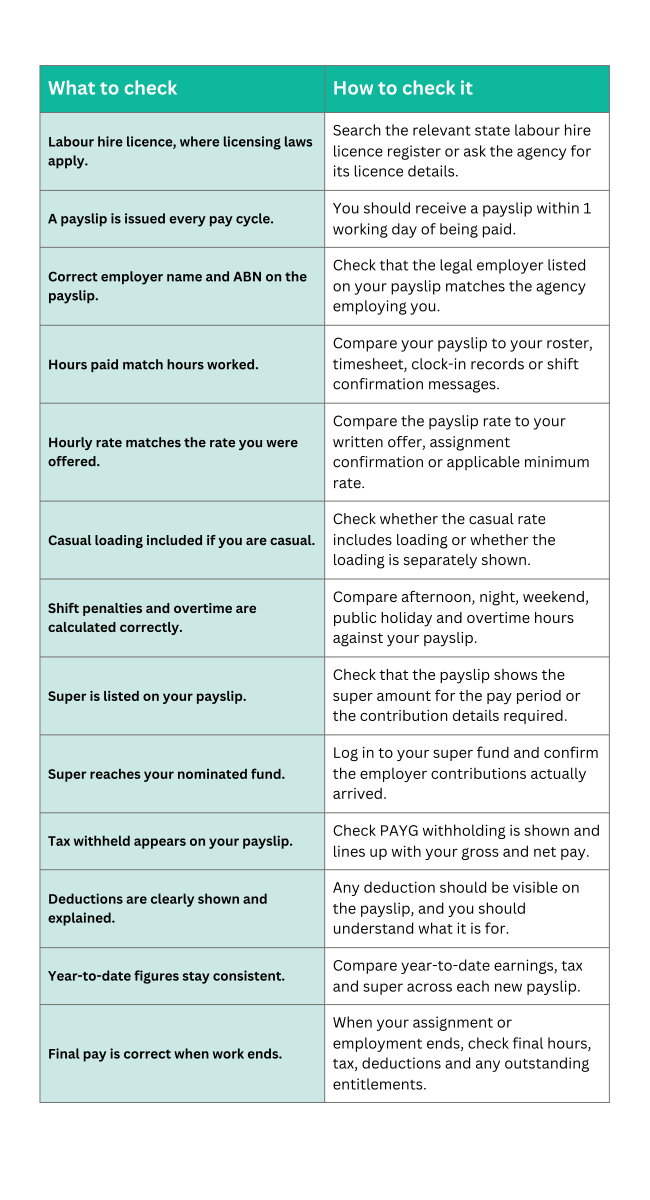
Payroll checks
Super is important, but it is only one part of employment compliance. If you work through a labour hire agency, you can also check the following items using your payslips, rosters, timesheets, super account and other records.

Related Blogs
Read news and insights into a variety of industries

10 Signs Of A Good Recruiter – A Guide For Job Seekers
A quick Google search and you’re likely to discover a mountain of readily available advice for job seekers; what’s lacking though, is literature that helps to determine the signs of a good recruiter from a job seeker’s perspective. As a job seeker, partnering with a recruiter can make or break your next move. And in…

5 Things Companies Can Do To Foster A Successful Recruitment Process
A recruitment provider can talk to no end about their proposition and how or why they might approach the recruitment process uniquely. However, the underpinning factors for truly successful hiring practices lie with how effectively the relationship between the provider and the organisation plays out. In the past, we’ve written about the need for recruitment…

Onboarding And The Importance Of Future-Proofing New Hires
According to Harvard Business Review, companies that onboard successfully are not only “more likely to retain their new hires” but also “report measurable profit growth”. We know this, there is a stack of evidence to back it up, and yet so many organisations continue to fall short of doing it well. ‘Death by induction’, as…

Why The Cost Of Underperforming Employees Is So Astronomical
A culture of underperformance can be insidious, culminating over time and making the pain points difficult to identify and combat. A problem that is so pervasive by nature, often only becomes evident in the wake of increasingly competitive markets, or when new leadership comes on board and inherits the issue. There are several reasons why…

Recruitment Providers: Out With Transactions, In With Partnerships
There is a lot of emerging talk about partnership-driven relationships between recruitment providers and businesses, particularly in today’s landscape that is driven by greater demand, accelerated technology, and the need for agility across all industries and departments. Market changes pose the case for a holistic hiring approach in a business climate that is strategy-driven and…

Hiring Attitude Over Skills And Why It Works
Media and industry discourse on how to tackle semi-skilled labour shortages has focused less on the importance of hiring on attitude, and more on the Australian Government’s plans to introduce Temporary Skill Shortage (TSS) visas of late. With that, countless reports have emerged, detailing shortages across various sectors. And rightfully so if we are to…
