



Your super is your money: How to check it’s being paid.
A practical guide for workers before Payday Super starts on 1 July 2026
Superannuation is not a bonus or a nice extra. It is part of your employment entitlement and part of your long-term financial future. If your employer is required to pay super for you, that money belongs in your nominated super fund.
The challenge is that many workers only check super once a year, or only look at the super amount shown on their payslip, without confirming whether the money actually reached their fund. That needs to change.
From 1 July 2026, Payday Super will require employers to pay superannuation contributions at the same time they pay wages, with contributions reaching the employee’s nominated super fund within 7 business days. This reform is designed to make unpaid or late super easier to identify and harder to ignore.
You do not need to wait until Payday Super starts. You can check your super now.
Why this matters
Super is your money. If it is not paid, is paid late, or is paid to the wrong fund, your retirement savings can be affected over time. For casual, shift, production, warehouse and labour hire workers who move between jobs or work variable hours, missed super can be easier to overlook.
Most employers do the right thing, but payroll mistakes can happen. Fund details can be wrong. Payments can fail. Amounts can be listed on a payslip before they have actually landed in the fund. That is why workers should check the numbers, not just assume everything is correct.
Check your super fund first
Log in to your super fund account and check the employer contributions that have actually been received. Look at the dates, amounts and employer name.
Check ATO online services through myGov. This can help you see super information reported to the ATO and find any lost or multiple super accounts.
Compare contributions against your payslips. Your payslips should show super contribution information, but the key question is whether the money has actually reached your fund.
Do a quick 12% sense check. For the current financial year, the Super Guarantee rate is 12%. As a rough check, take your ordinary time earnings for the year and multiply that amount by 12%.
Quick super sense check Ordinary time earnings for the financial year x 12% = approximate super that should be paid.
Example: $45,000 x 12% = $5,400
Important: this is a practical sense check, not a final legal calculation. Super is generally calculated on ordinary time earnings until 30 June 2026. From 1 July 2026, the Payday Super rules use qualifying earnings for SG and SGC purposes.
If the amount in your super fund is much lower than expected, do not ignore it. There may be a reasonable explanation, such as quarterly payment timing, salary sacrifice, overtime treatment, fund processing delays, a correction still being processed or a payment made to another fund. However, you should ask the question and get a clear answer.
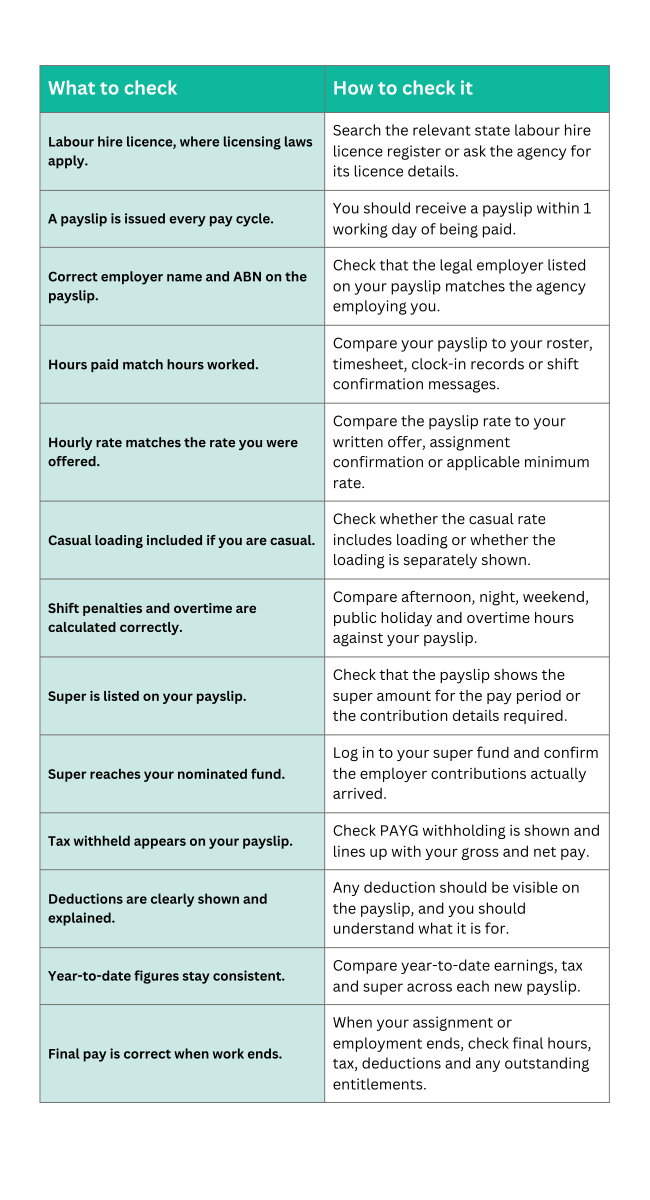
Payroll checks
Super is important, but it is only one part of employment compliance. If you work through a labour hire agency, you can also check the following items using your payslips, rosters, timesheets, super account and other records.

Related Blogs
Read news and insights into a variety of industries

Labour Hire Licences Are Being Cancelled. Is Your Business Exposed?
On 26 June 2026, Victoria’s Labour Hire Authority (LHA) cancelled the labour hire licence of Hudson Global Resources Pty Ltd, one of the best-known names in Australian recruitment. The regulator found the company’s directors were not fit to run a labour hire business, citing widespread legal non-compliance and significant outstanding debts. From 10 July 2026,…

Which roles are hardest to fill in Australian manufacturing right now?
If you run a manufacturing, food processing, or distribution site anywhere in Australia, you’ve felt it: some roles can be staffed in days, while others sit open for weeks, costing you overtime, missed shifts, and production delays. This article breaks down which positions are hardest to fill in 2026, where the gaps are worst (by…

What Does a Casual Worker Actually Cost You?
Before you compare an hourly rate, make sure you’re comparing the whole cost. Here’s what typically sits on top of a casual’s base pay and why a staffing partner’s bill rate is usually a fairer comparison than it first looks. When employers weigh up managing casuals directly against using a staffing agency, the comparison usually…

Payday Super Starts 1 July 2026: What Employers & Managers need to do now.
Payday Super is not just a payroll change. It is a compliance change. From 1 July 2026, Australian employers will need to pay superannuation much closer to the time they pay wages. For businesses with simple, salaried workforces, that is still a meaningful change. For food production, pharmaceutical manufacturing, warehousing, distribution and industrial operations, the…

Stop treating temp workers like executives: Why your hiring process is broken.
Employers who insist on executive-style, multi-stage interviews for casual and temporary staff are losing good candidates, damaging their brand, and may not understand the current market. This is especially true for blue collar and hands-on production and process workers, where speed, clarity, and respect for the candidate’s time are critical. Casual and blue collar roles…

Speed to Hire
Why Lengthy Interview Processes are costing Employers Great Workers. In today’s labour market, particularly across manufacturing, warehousing, logistics and manual labour roles, one truth is becoming increasingly clear: speed to hire is no longer a “nice to have” – it is a competitive advantage. Yet many employers continue to apply white-collar hiring frameworks to blue-collar…
