



Your super is your money: How to check it’s being paid.
A practical guide for workers before Payday Super starts on 1 July 2026
Superannuation is not a bonus or a nice extra. It is part of your employment entitlement and part of your long-term financial future. If your employer is required to pay super for you, that money belongs in your nominated super fund.
The challenge is that many workers only check super once a year, or only look at the super amount shown on their payslip, without confirming whether the money actually reached their fund. That needs to change.
From 1 July 2026, Payday Super will require employers to pay superannuation contributions at the same time they pay wages, with contributions reaching the employee’s nominated super fund within 7 business days. This reform is designed to make unpaid or late super easier to identify and harder to ignore.
You do not need to wait until Payday Super starts. You can check your super now.
Why this matters
Super is your money. If it is not paid, is paid late, or is paid to the wrong fund, your retirement savings can be affected over time. For casual, shift, production, warehouse and labour hire workers who move between jobs or work variable hours, missed super can be easier to overlook.
Most employers do the right thing, but payroll mistakes can happen. Fund details can be wrong. Payments can fail. Amounts can be listed on a payslip before they have actually landed in the fund. That is why workers should check the numbers, not just assume everything is correct.
Check your super fund first
Log in to your super fund account and check the employer contributions that have actually been received. Look at the dates, amounts and employer name.
Check ATO online services through myGov. This can help you see super information reported to the ATO and find any lost or multiple super accounts.
Compare contributions against your payslips. Your payslips should show super contribution information, but the key question is whether the money has actually reached your fund.
Do a quick 12% sense check. For the current financial year, the Super Guarantee rate is 12%. As a rough check, take your ordinary time earnings for the year and multiply that amount by 12%.
Quick super sense check Ordinary time earnings for the financial year x 12% = approximate super that should be paid.
Example: $45,000 x 12% = $5,400
Important: this is a practical sense check, not a final legal calculation. Super is generally calculated on ordinary time earnings until 30 June 2026. From 1 July 2026, the Payday Super rules use qualifying earnings for SG and SGC purposes.
If the amount in your super fund is much lower than expected, do not ignore it. There may be a reasonable explanation, such as quarterly payment timing, salary sacrifice, overtime treatment, fund processing delays, a correction still being processed or a payment made to another fund. However, you should ask the question and get a clear answer.
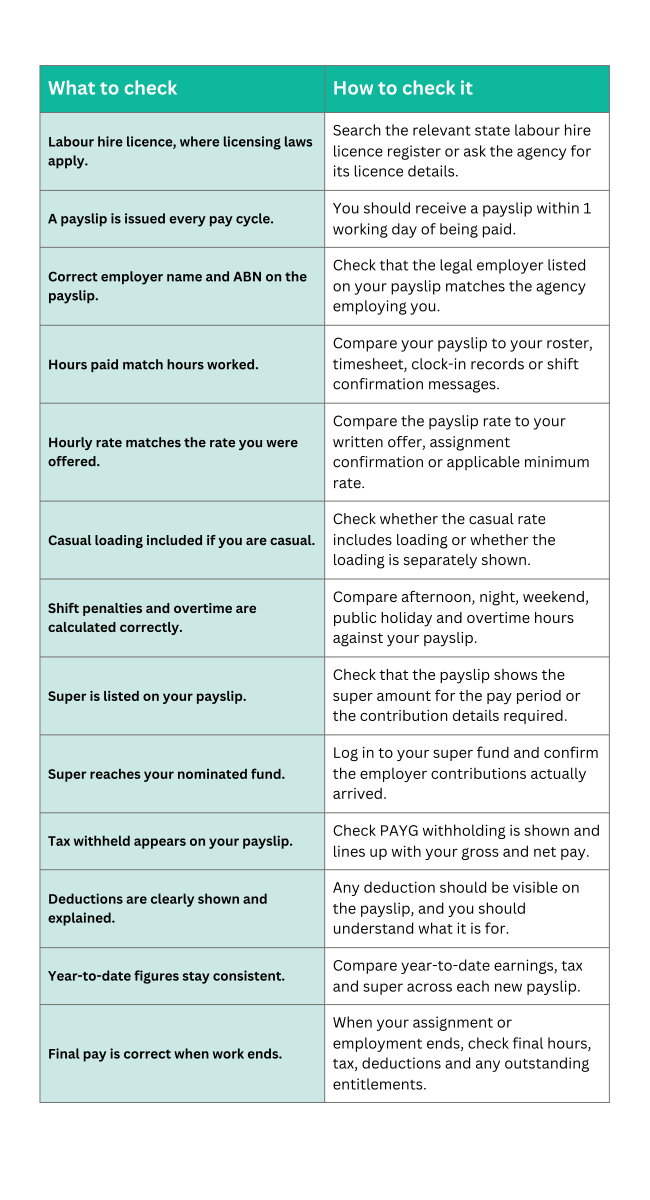
Payroll checks
Super is important, but it is only one part of employment compliance. If you work through a labour hire agency, you can also check the following items using your payslips, rosters, timesheets, super account and other records.

Related Blogs
Read news and insights into a variety of industries

Essential skills to gain more work with Blaze Staffing.
Working in food processing, packing and warehousing offers reliable work opportunities in the current market, but to make the most of them, it’s important to invest in your skills, workplace behaviour, and personal wellbeing and safety. This is the essential guide to ensuring you gain more shifts, stay safe, and build a reliable and trustworthy…

How to get your seasonal workforce up to speed without compromising quality.
As the summer peak approaches, many Australian food manufacturing businesses are preparing for increased production. Orders are rising, shifts are expanding, and the need for reliable staff is more urgent than ever. The challenge is not just finding enough people, but finding skilled and safe workers who can perform from day one without disrupting operations….

Aged Care 2025 Regulatory Changes at a Glance
Aged Care 2025 Regulatory Changes at a Glance The aged care sector in Australia continues to face significant regulatory change, with new compliance requirements reshaping how providers manage their workforce. In 2025, three of the most pressing issues for aged care providers are Fair Work Commission wage increases, the requirement for Registered Nurses (RNs) to…

Is chasing cheaper labour actually costing you more?
Is chasing cheaper labour actually costing you more? It is tempting, isn’t it? The budget is tight, orders are piling up, and there’s that agency promising they can get you staff at a rate that looks too good to be true. Spoiler alert: it usually is. What looks like a saving on paper often morphs…

Scaling up without slowing down: Workforce planning strategies for peak periods
In Australia’s food, pharmaceutical, and manufacturing industries, demand rarely follows a straight line. Whether it’s the lead-up to Christmas, an unexpected product launch, or fulfilling large-scale export orders, periods of peak production can stretch even the most robust internal teams. Yet without the right workforce planning strategies in place, these surges can become a liability—causing…

Make Sure Your Hiring Practices Aren’t Doing Your Brand Damage.
For businesses operating in fast-paced, high-compliance sectors like manufacturing, food production, and pharmaceuticals, recruitment is often seen as a matter of urgency. You need boots on the ground. You need people yesterday. But here’s the hard truth: if your hiring process is rushed, disjointed, or inconsistent, it’s not just costing you candidates-it’s damaging your brand….
